Meet Anastasia: On a mission to improve respiratory care
Behind every breakthrough are people whose daily work often goes unseen - but whose impact is extraordinary. One of them is Anastasia de la Haye.
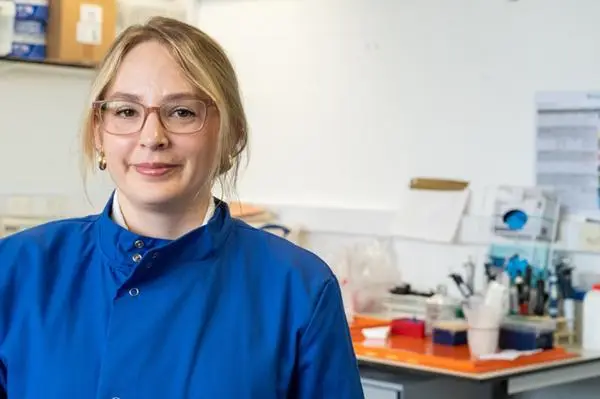
She has been working at University Hospital Southampton for five years and leads the respiratory research lab. She is funded by both the NIHR Southampton Biomedical Research Centre and Clinical Research Facility (CRF).
We sat down with her to explore what a day in her world looks like, and what advice she has for the next generation.
Why did you want to be a lab technician?
Before this job, I worked in customer facing roles, but I was always interested in research, evidence-based practice and improving services. I liked the idea of contributing to something that helps people receive better care. Even though I’m not the one treating patients directly, I play a part in the chain that leads to new discoveries and improved treatment.
What kind of education or training do you need to work in a lab?
To work in this role, you need a science degree, ideally with some lab-based modules. I had already built lab experience by working in a veterinary laboratory, where I learned to use equipment like centrifuges. Those skills transferred easily into clinical research‑based modules.
This lab is mainly a preparation lab, meaning we prepare samples for analysis elsewhere. Deep analytical training isn’t always required at the start.
When I took on my current role, I spent a few months training with the previous lab lead to learn specific methods required for respiratory sample processing. I built on processes I had previously learned working as a technician in the CRF labs such as PBMC isolation - a method for separating certain types of blood cells. The processes are similar and are used in an increasing number of studies, so it was important training for the work I do now.
What skills are required in your daily work?
You need:
- Excellent attention to detail – because samples must be handled precisely
- Adaptability – plans can change quickly
- Awareness of the bigger picture – every sample is part of an important research journey, so you need to respect its value
What does a typical day look like in your work?
Every day in this job looks a little different. Our CRF lab supports around 350 active studies. There are only three of us in our Respiratory Research Lab team and we focus on the studies that require respiratory sample processing such as bronchoscopy or sputum samples.
My day could begin with a bronchoscopy. We join the nurses during the procedure, collect the samples - such as biopsies and brushings - and check the sample quality. Most of these participants have asthma or COPD.
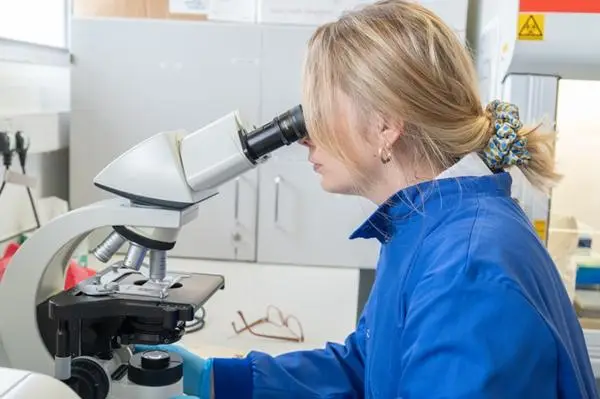
Once we get the samples to the lab, we spend about three to four hours processing them. Throughout this time, we keep careful records, count the sample’s cells under a microscope, and freeze the samples. These samples take time and specific training to process, which is why we support fewer studies than the main CRF lab.
We also travel to the Isle of Wight to process sputum samples at the David Hide Centre.
On top of the practical work, I help write SOPs (standard operating procedures) and lab manuals. These documents guide how things should be done in our lab and sometimes even influence how other sites work.
Occasionally, I work with infectious samples, such as during Covid-19 or for studies like UNIVERSAL. We use special safety cabinets that we place the samples and our hands into. These isolate the cabinet environment using airflow and filters to protect anyone external to the cabinet from infection.
What do you love most about your job?
I love the variety of the work and the team I get to work with. We have a really supportive environment, everyone gets along, and we also enjoy social outings outside of work.
Is there a moment that stands out that you’ll always remember?
My first bronchoscopy definitely stands out. It was stressful at the time, but I felt proud afterwards. I now train other people to do them, and I’ve completed around 30 in the past year.
Another proud moment was being published in the paper for a national trial into Covid-19 booster vaccines. Our hospital was the lead site, and it felt great to be recognised for our work. My manager, Gavin, wrote the lab manual, and the team all contributed.
What advice would you give someone who wants to be a lab technician?
Talk to people in the field and try to get hands-on experience in a lab if you can.
A science qualification is helpful but having lab experience is invaluable, and you can also ask local hospitals if they offer lab tours. Networking and getting to know people in research can create lots of opportunities for shadowing or advice.