Surgeon recognised with international award for advancing kidney stone treatment
Southampton surgeon Professor Bhaskar Somani has received a prestigious award for his research into kidney stone treatments.
He has been presented with the Christian Chaussy Award by the German Society for Shockwave Lithotripsy.
Professor Somani is a consultant urological surgeon at University Hospital Southampton (UHS). He has been supported by the UHS Research Leaders Programme.
He was presented with the award at the annual German Urology Congress 2026 in Düsseldorf. He is the first UK urologist to receive this award.
The award recognises pioneering work led by Professor Somani and developed at UHS. This brings together cutting-edge technology, research and patient-centred care within the kidney stone service.
What is shockwave lithotripsy?
Stones form when waste products in the blood collect inside the kidneys and build up into hard, stone-like lumps.
While many are small enough to pass naturally, larger stones can cause severe pain and require removal. If left untreated, they can lead to infections or impaired kidney function.
Shockwave lithotripsy is a non-invasive treatment that uses high-energy sound waves. This breaks down kidney stones into smaller fragments that can be passed naturally. It is also known as extracorporeal shockwave lithotripsy (ESWL).
This procedure offers a safer alternative to open surgery. It treats kidney stones with minimal damage to the kidneys and surrounding tissues. This reduces recovery time and improves patient outcomes.
Using virtual reality to improve patients' experience
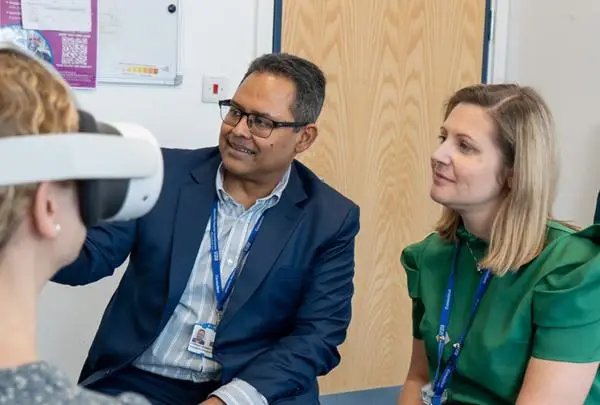
The Christian Chaussy Award 2026 celebrates innovative work at UHS. This is using virtual reality (VR) to enhance patient counselling and consent for shockwave lithotripsy.
The project involved medical students, clinical fellows and stone specialist nurses. The results have recently been published in the Journal of Endourology.
It is further recognition of UHS's growing international reputation in kidney stone research.
Earlier this year, UHS featured in a global analysis published in Urolithiasis. This recognised UHS as the world's leading centre for clinical research into kidney stone treatment.
Recognising research leadership
Professor Somani was a member of UHS's Research Leaders Programme. This identifies staff with the potential to become future research leaders.
The programme provides dedicated time, training and personal development opportunities. This supports members to progress their research careers.
Professor Somani's current research focuses on the use of artificial intelligence (AI) to improve care. This is aimed at helping patients having surgery involving the kidneys, ureters, bladder and prostate.
Earlier this year he was awarded the John Anderson Award 2026 from British Association of Urological Surgeons.
This recognised him as an outstanding urologist. It commended him as inspirational in teaching, training, service development and service delivery.
Professor Somani said:
“I am incredibly honoured to receive the Christian Chaussy Award and to be the first urologist from the UK to receive this recognition.
“This award reflects the collective efforts of our entire multidisciplinary team at UHS, whose commitment to innovation, research and patient-centred care continues to drive improvements in kidney stone treatment.”
Paul Grundy, chief medical officer, UHS, said:
“This international recognition is a testament to Professor Somani's commitment to improving care for patients with kidney stones through innovation, research and education.
“The work recognised by this award demonstrates how combining cutting-edge technology with a patient-centred approach can enhance both the patient experience and clinical outcomes.
“We are proud to support clinicians who are pushing the boundaries of research and translating new ideas into real benefits for patients.
“This award, alongside our growing reputation as a global leader in kidney stone research, reflects the dedication, expertise and collaborative spirit of Professor Somani and the wider multidisciplinary team.”